

Time:2026-04-25 Views:0
Curved staircases, while visually stunning, require specialized safety features to address the unique challenges posed by their curved design, such as uneven tread widths and potential visibility issues. One of the most critical safety elements is the consistent tread depth and riser height. To comply with international safety standards, manufacturers ensure that tread depths increase uniformly from the inner to the outer curve, preventing tripping hazards, and that riser heights remain constant throughout the staircase. Handrails are another essential safety feature; they must be continuous along the entire curve, with a comfortable grip diameter (typically between 30mm and 50mm) and a height of at least 900mm for residential spaces and 1100mm for commercial areas. Additionally, the gap between balusters (spindles) is strictly regulated, usually no more than 100mm, to prevent small children or pets from getting stuck.
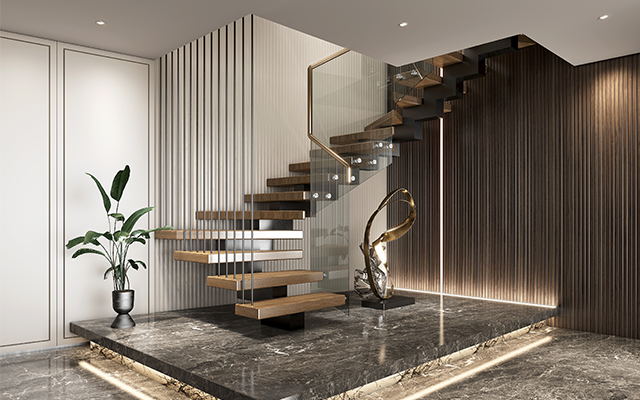
Beyond basic handrails and tread specifications, modern curved staircases incorporate advanced safety features to enhance usability and reduce risks. Non-slip tread surfaces are a common addition, with options ranging from textured wood finishes and rubber inserts to anti-slip coatings, ensuring traction even in wet conditions. For larger or more complex curved designs, integrated lighting systems are increasingly popular—LED strips installed under handrails, in tread nosings, or along the staircase’s stringers provide illumination that highlights the curve and improves visibility, especially in low-light environments. Structural stability is also paramount; curved staircases rely on robust stringers (the side supports) and landings that are properly anchored to the building’s structure to prevent wobbling or collapse. Some high-end models even include weight sensors or safety gates for added protection, making curved staircases a safe choice for households with children or elderly residents when equipped with these thoughtful features.










 CN
CN