



Time:2026-04-10 Views:0
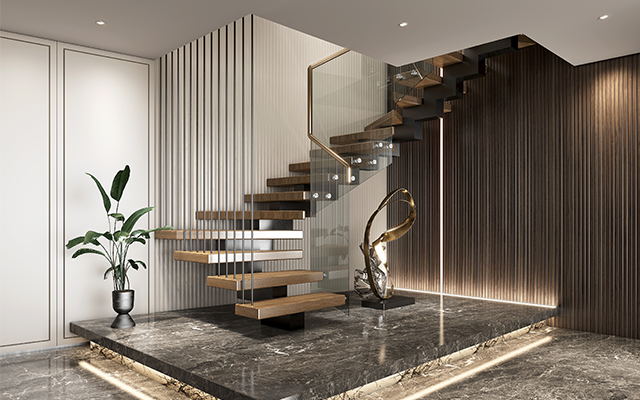
Custom curved staircases are celebrated for their ability to fit unique spatial constraints and design visions, but their dimensions require meticulous planning to balance aesthetics, safety, and functionality. Unlike straight staircases with standardized measurements, curved designs demand precision in radius, tread dimensions, and headroom to ensure a comfortable and code-compliant ascent. The first critical dimension is the inner radius, which dictates the staircase’s footprint and the tightness of the curve. For residential spaces, a minimum inner radius of 1.2 meters (4 feet) is recommended to prevent overcrowding and allow comfortable movement, while commercial or grand residential settings may opt for radii of 1.8 meters (6 feet) or more to enhance elegance and flow.
Tread dimensions are equally vital; each tread’s depth (from front to back) must be consistent at the walkline (the area where feet make contact) to avoid tripping hazards. A minimum tread depth of 250 millimeters (10 inches) at the walkline is standard, with the outer edge of the tread typically extending slightly to maintain this consistency around the curve. Rise height, the vertical distance between consecutive treads, should be uniform and fall between 150-190 millimeters (6-7.5 inches) to ensure a natural stride. Additionally, headroom (the vertical clearance above the staircase) must be at least 2.0 meters (6.5 feet) at all points to accommodate tall individuals and comply with building codes. Finally, the width of the staircase, measured at the walkline, should be a minimum of 900 millimeters (36 inches) for residential use and 1.1 meters (44 inches) for commercial spaces, ensuring ample room for two people to pass if needed.







 CN
CN